Map a Profitable Line and Operate Trains
An innovative and cult game, from the 1970s, Railway Rivals was a board game without a board. Originally, you had to order a copy, by post, from the Welsh school teacher inventor. It came in a 50cm long cardboard tube that contained a map of your choice, counters, dice, rules and pens.
It's a long time since I have played it, but I recall it with great affection. Browsing through the articles I wrote for my local paper I decided it really was one of the best I bought at that time and ought to be added to the site.
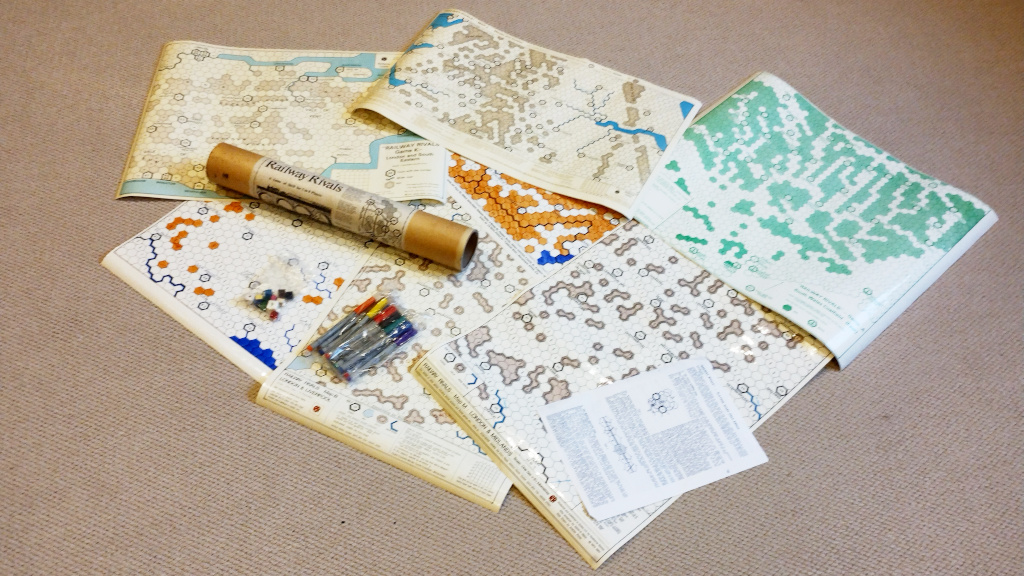 My collection of maps on which to play "Railway Rivals". Some
were bought from the inventor. He also sold blank maps on
which you could create your own or copy the designs of other
enthusiasts published in fanzines. My collection includes
some of those.
My Newspaper Column
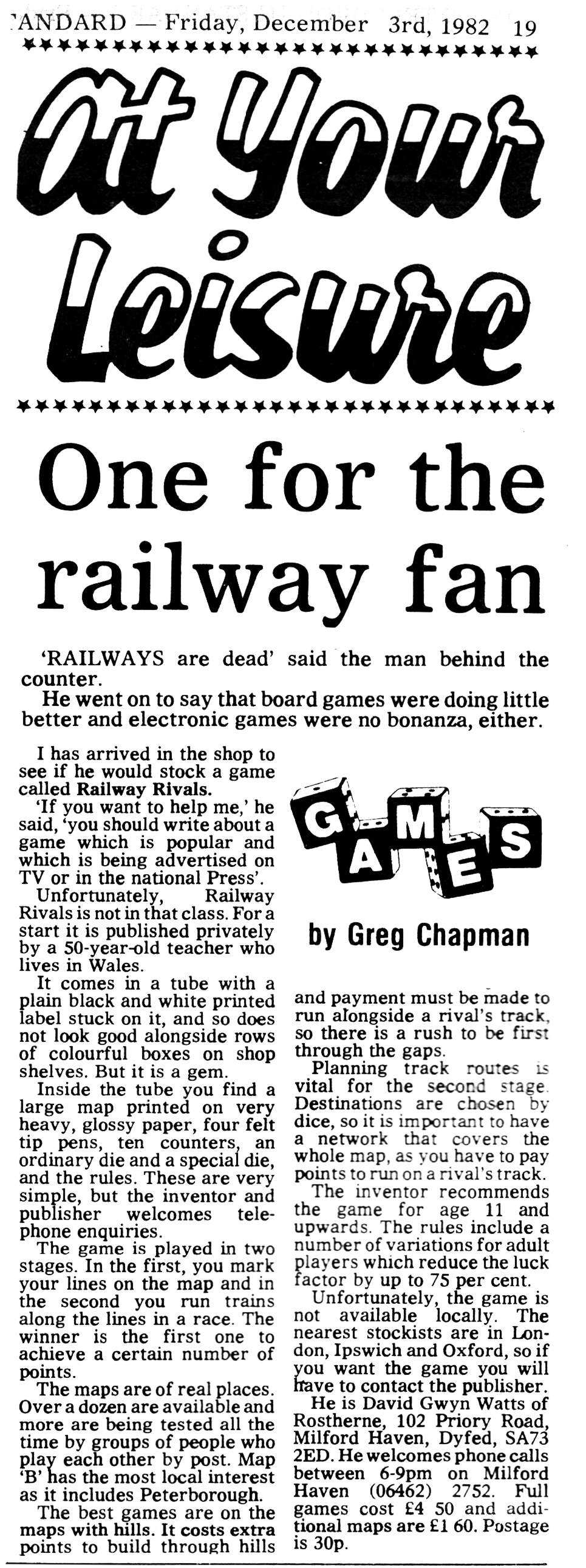
In 1982 I wrote a pre-Christmas column in the Peterborough Standard, the city's local newspaper. Along with Blockade and Mystic Wood, Railway Rivals was one of the games I covered in the few weeks that I was writing it. A photocopy of the article appears here. (Click/tap on the image to see a larger version that may be easier to read.) I was aware that a more conventional boxed version of the game with a board had been published in Germany but, in those pre-internet days that wasn't going to be of much interest to the casual games buyer in Peterborough. It wasn't until 1985 that Games Workshop produced a boxed version in the UK.
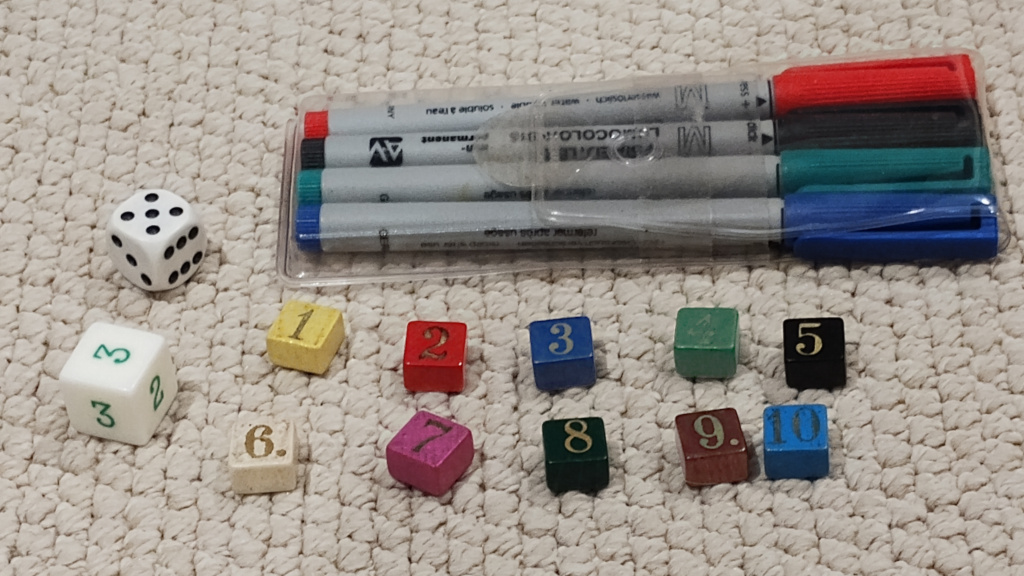 The pens counters and dice that came with my copy of the game.
The article describes the cardboard tube in which the game came, along with a pack of four pens, ten counters and dice. Reading the article for the first time in many years I was surprised when I read of ten counters being included in the package as I knew that the label on the cardboard tube in which my first map came talked of 3-8 players. However, on checking, sure enough, my tube did contain ten counters. I read elsewhere that some maps allow for up to ten players and one of mine does say the map should be used by between five and nine players.
One thing the article does not do is link the reference to a special die and the variant rule for adults that reduces the luck element by 75%. While the rule sheet I have does, referring to an "average die". This dispenses with the numbers one and six, replacing them with second copies of three and four, thus ensuring die rolls are much less likely to differ wildly.
The Rules Sheet
I am not sure how much the rules varied over time. A note in Section D of the doubled sided A4 sheet that I have says it was being printed in January 1980. It's headed "Third Edition" and there are copyrights dated 1973, 1976 and 1980 at the bottom of the second side, which I assume are the dates of each edition.
The closely typed two sides start with an introduction and then a number of sections labelled A-F. Sections A-B cover the railway building and operating stages. Sections D-F mainly cover a selection of different updates and refinements to particular maps. Reading between the lines it would appear that some maps were issued in what might be termed "draft" form, lacking the panels that define the starting towns and rules for "special runs" in the operating stage that appear in later reprints. In a few cases it would seem that after play-testing a map some hills and towns were deemed to need relocation.
Almost half the second side of the rules sheet is occupied by "C. Variants". I generally disapprove of alternative rules in games. So often they indicate a motley collection of rules designed to overcome flaws in the original rule set. However, in this case, they all appear designed lift the game as it would have been played in the classroom to one that would appeal to adults. Most are designed to reduce any luck element caused by the use of dice while others to attempt better simulation of what actually happened during the railway building boom of the late 1800s.
The Maps
As you might guess, given that it was invented by a geography teacher, Railway Rivals started life as a teaching aid. David Watts worked in Pembrokeshire and his first map covered the nearby Welsh coalfield and was later known as "Map A: South Wales Coalfield (East)". I've read that after a game many players will examine the lines created in their game to see how closely they mirrored actual history. I confess I am counted amongst that number.
My first purchase was of "Map B: London and Liverpool" which covered Peterborough where I then lived, but I went on to buy further maps, either because I had an interest in the areas they covered or because various reviewers suggested they provided some point of interest in play, so my collection of maps ended up including the very open prairies of the USA to the mountains of Switzerland as well as various areas of England. Some of these were hand coloured on blank hex sheets that David provided.
Summary
As you might gather, I like this game. It's worthwhile on so many levels. It's rules are only a little more complex than those of Ludo so easy enough to for those not familiar with the game to pick up. While David Watts may have been a secondary school teacher and that might account for him suggesting 11 as the minimum age, I reckon those a couple of years younger would not find it difficult to play, even if they didn't fully appreciate the finer points of strategy. Playing on a map with local interest will always appeal. It will appeal to others because of either the period of history it simulates or the railway theme. In short, it's the kind of game you can pull out of the cupboard whenever a group decides it's time for a board game.
Post Script
Trawling the Internet today I find that the rights to Rostherne Games passed to one Theo Clarke in 1998, but he appears to be untraceable and is reported as having been unwilling to authorise reprints of the boxed versions.
While you find plenty of material on the, now out of print, boxed versions of Railway Rivals, the information that is available on the versions published privately by David Watts himself is scattered across a number of sites, some of which have not been updated in nearly 20 years. It is my plan to bring together all that material in a new section of this site.
In the meantime for those who have a greater affinity with the Games Workshop version it would be a good idea to keep an eye on railwayrivals.co.uk as MarionM has already produced a kit for a version of the game she calls "Rail Victoria" and plans to release an on-line version of the game.