Easy to Learn, Hard to Master
That's the strap line on the box and after just a couple of games I think it may be exactly right. I'm really intrigued by this game. Because of the name and cherry blossom decoration to the box and board, at first I thought it was of ancient Japanese origin, but it turns out it is a recent invention but I have found nothing about the inventor beyond his name, Raymond Haysman.
The game was bought for us, out of the blue, as a Christmas present in 2025, by our daughter, and is not one I had expressed any interest in, indeed I wasn't even aware of it.
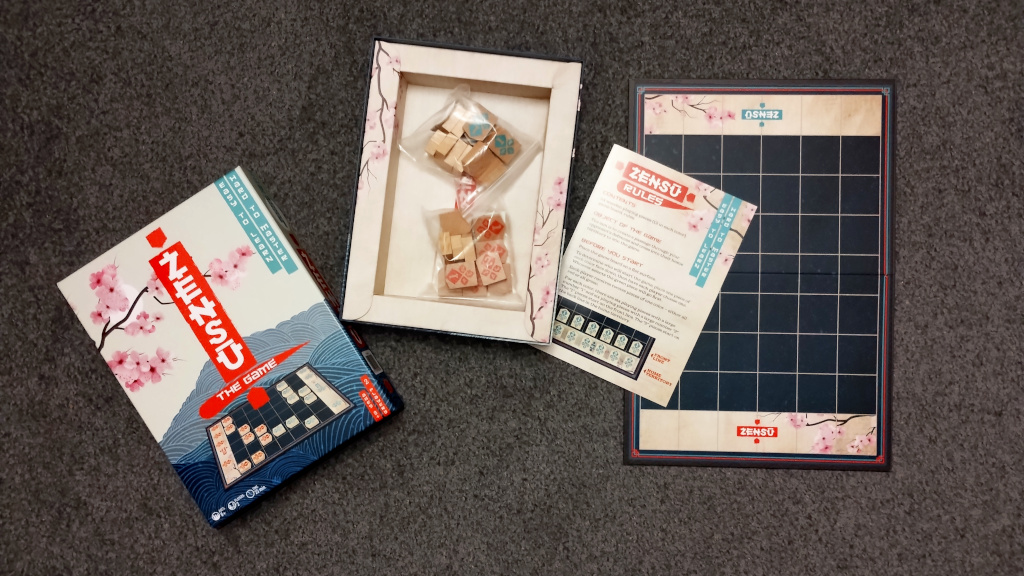 Inside the box are two bags, each containing 12 playing pieces,
which are of two kinds, a four page rules leaflet and a board showing a 9x6 playing area.
The Board
It may not be obvious when you first see the board, but it's 9 by 6 squares not 7 by 6. That's because the two rows with floral decoration at each end of the board are part of the playing area and not just decoration. They are the target rows that each player needs to get one of their pieces onto to win the game. The game can also be won if all enemy pieces are captured.
The Pieces
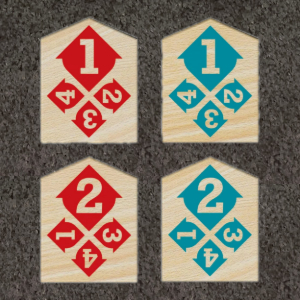
Each player starts with 12 playing pieces, six of each of the two types. Those with a bold 2, start on the back row, while those with a bold 1 start one row forward. The pieces must always point towards the back row at the other end of the board. You'll notice that the numbers on the pieces run clockwise from 1-4. These numbers indicate how far a piece can move in that direction, and they must move exactly that number.
Capture
The pieces may pass over others as part of their move. Any enemy piece passed over is captured and removed from play. The finishing square on a move must be vacant or occupied by an enemy piece and, if an enemy piece, this too is captured. Multiple captures in a single turn are, therefore, possible.
The Rules
In some ways the rules are over long. While it is good to see diagrams that illustrate the meaning of a rule, as many people learn visually rather than by reading, in places they are repetitious, adding a phrase or sentence that has to follow logically from what has gone before. For example, "The game cannot end in a tie"and "Pieces cannot be moved off the edge of the board" or a rule that specifies how to select the player to play the green pieces and start play, or this:
If a player intentionally touches one of their pieces, they must make a move with this piece if a legal move is possible. Pieces can be adjusted on their squares if necessary, but this should be announced in advance.
Don't most households or games groups have their own house rules to cover such issues?
I'm also never sure whether "Hints and Tips" should appear in a rule book. If the rules are well written any suggestions about playing techniques are likely apparent to any player who appreciates their implications. Surely, part of the joy of a game with rules as simple as those for this game, is working out how best to take advantage of them, not to be told obvious implications.
Conclusions
I haven't played the game often enough to feel that I have any kind of mastery of it and that is a good thing. It means I have a lot more to explore and it will continue to offer a challenge for some time yet. I'm still looking for techniques that make best use groups of pieces for either attack or defence. Now why don't they appear in the hints and tips?